Why High-Achieving Women Struggle to Switch Off
16 Sept, 2026



Once primarily associated with financial control, reporting and stewardship, today’s CFO is expected to be far more than the organisation’s financial gatekeeper. They are strategic advisers, transformation leaders, commercial partners, people leaders and increasingly, the voice of reason when organisations are navigating uncertainty.
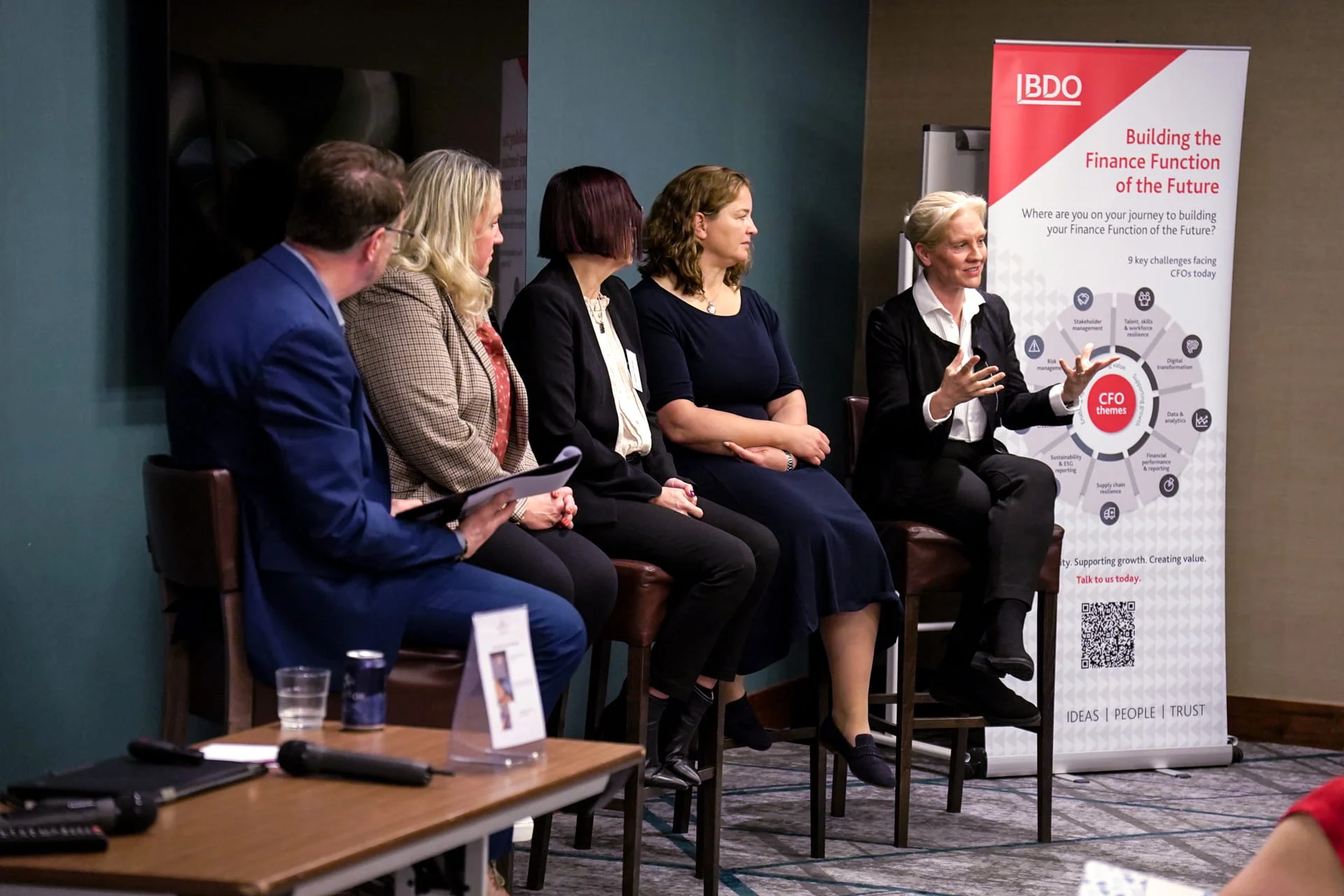
That evolution was at the heart of our recent CFO panellist event, jointly hosted with BDO. What made the discussion particularly notable was the panel itself: four senior CFOs, all women, sharing their experiences of leading finance functions and businesses through a period of significant change.
Rachel Yoxen of TM Forum, Sarah Cramer of Agito Group, Sarah Herriman of Toob and Pippa Horne of HUB, an Osttra company, each brought different experiences and perspectives to the conversation. Yet there was considerable common ground in how they described the CFO role: broader, more strategic, more commercially focused and more influential than ever.
Their discussion also provided a powerful reflection of how far the profile of female finance leadership has evolved. These are not finance leaders operating solely within the traditional boundaries of the function. They are influencing strategy, technology, people, operations and the future direction of their organisations.
As Emma Chesson, Finance Function of the Future lead for BDO, explained, “Previously, it was more traditional and very numbers focussed, but now we're seeing that the CFO is really grappling with driving change and creating value in the organisation.”
BDO has explored this evolution extensively through its research with ACCA, Chief Value Officer – The Important Evolution of the CFO, which draws on interviews with 100 global CFOs.
One of the clearest themes from the panel was the extent to which CFOs have moved from being financial advisers to becoming genuine strategic partners to the CEO.
As Sarah Herriman explained, “when we talk to investors and fundraisers, they look at you as a duo.”
That relationship reflects what we increasingly see in the recruitment market. Organisations are no longer simply looking for a technically strong finance leader. They need someone who can challenge decisions, contribute to strategy and help turn ambition into action.
Sarah Cramer captured this shift when she said, “it’s not just about the numbers, but what do you think? What's your perspective? What could go wrong? How could I look at this in a different way?”
Rachel Yoxen highlighted another advantage of the CFO position: its unique view across the organisation.
“I think we are in such a unique position because we span across all areas and all departments, and there's very few roles in an organisation that do that. So I'm very much the right hander, the chief executive will frequently ask for my opinion and my judgement call on things because he will know that I will have the insights.”
That breadth of experience is increasingly important. CFOs are often operating across finance, HR, legal, compliance, technology, health and safety and operations, while simultaneously being expected to maintain a clear view of the organisation's financial performance.
As Rachel summarised, “you actually become a lot more strategic working shoulder to shoulder with the CEO. You will grow exponentially, drive the business and advise them. It's about more than just numbers.”
Pippa Horne described the challenge of balancing that strategic role with the need to remain accessible across the organisation: “You've got to be advising on slightly different areas and be approachable to everyone at the same time.”
That ability to move between the detail and the bigger picture has become one of the defining characteristics of the modern CFO.
The fact that all four CFOs on the panel were women was significant, but what stood out most was how naturally they occupied that space.
The discussion was not about whether women belong in the CFO role. It was about what it means to operate at that level of leadership and how the role itself is changing.
Their experiences demonstrated the increasingly broad definition of finance leadership. These CFOs are influencing business strategy, advising CEOs, leading transformation, managing technology and data challenges, developing their teams and helping shape organisational culture.
That matters because representation at this level changes perceptions of what senior finance leadership looks like.
It also provides a useful reminder that the pipeline into senior finance roles is not simply about technical progression. Today's CFO needs commercial confidence, communication skills, curiosity, adaptability and the ability to build relationships across an entire organisation.
The panel demonstrated that female CFOs are not simply succeeding within the traditional definition of the role. They are helping to redefine it.
Technology was another major theme of the discussion, particularly the growing influence of AI.
The BDO research highlighted an important point: technology alone does not deliver transformation. As Emma Chesson noted, “True transformation projects don’t work when you don’t engage the people and look at the workforce and the skills they’ve got.”
The CFOs on the panel echoed this, discussing legacy systems, manual processes and the challenge of helping finance teams understand how AI can genuinely improve the way they work.
Sarah Cramer emphasised the importance of developing capability internally: “unless you train your own department on AI, how do you know what to deliver?”
For Rachel, the opportunity is about enhancing the role of finance rather than removing it.
She described using AI to generate tailored insights for budget holders in minutes rather than weeks, explaining, “for me it's not taking things away. It's upskilling and it's really enhancing the value that you can add.”
That distinction is important.
The future is unlikely to be about AI replacing finance professionals. It is about finance professionals using AI to move away from repetitive activity and towards higher-value work involving insight, challenge, commercial decision-making and relationships.
Human judgement still matters
For all the discussion about technology, there was an equally strong message from the panel: human judgement is becoming more important, not less.
Data may be more accessible than ever, but information without context does not necessarily lead to better decisions.
As Pippa put it, “context is everything… without it, data creates confusion.”
Rachel also highlighted the risk of becoming too reliant on technology: “you could lose your critical thinking skill set.”
That is why communication and relationship-building remain such important parts of the CFO role.
As Sarah Herriman observed, “everyone has the data at their fingertips.” The value of the CFO increasingly comes from understanding what that data means, challenging it where necessary and explaining what the organisation should do next.
Rachel summed this up well: “human perspective is really important, and people want that as well. They don't want to sit and have a review meeting with an agent or bot.”
For finance teams, that means AI should create more time for people to engage with the wider business rather than simply creating more output.
Rachel has been particularly direct with her own team about this change, telling them: “your role is not going to disappear, but your role is going to change.”
The opportunity is to spend less time processing information and more time “engaging in meetings and working with people and learning about what's going on in the business”.
The panel also explored the growing responsibility CFOs have around governance, ethics and organisational trust.
As AI becomes more embedded in business and data becomes increasingly accessible, finance leaders are having to think carefully about how technology is used, where the boundaries sit and how organisations protect the information they hold.
Sarah Herriman described this as “an ethical challenge because you actually want to progress the business, but also you’re the guardian of the data.”
It is another example of how the CFO role has expanded.
The modern CFO is expected to support innovation while also understanding risk. They need to encourage organisations to embrace new technology without losing sight of governance, accountability and the people affected by those decisions.
For organisations recruiting their next CFO, the implications are significant.
Technical finance expertise remains fundamental, but it is no longer enough on its own.
Today's CFO needs to be commercially minded, digitally confident, strategically capable and comfortable leading change. They need to communicate effectively with investors and boards, challenge the CEO when necessary, understand the wider organisation and develop the people around them.
The discussion also reinforces the importance of looking beyond traditional career paths when identifying future finance leaders.
The four women on our panel each brought different experiences to the CFO role, but all demonstrated the same ability to operate beyond the traditional boundaries of finance.
That is increasingly what organisations need: finance leaders who can see the whole business, not just the numbers.
From looking backwards to predicting what's next
Pippa captured the changing nature of the role when she reflected:
“you look at your calendar back then at all the historic looking meetings, and now you've got to be predicting the future.”
Sarah Cramer echoed this, saying, “it's about assessing…what skillset you've got and what you actually need. And what you need today isn't necessarily what you need in 12 months’ time.”
That may be one of the biggest challenges facing today's CFO.
The role is continually changing, which means the skills required of tomorrow's finance leaders will also change.
As businesses become more technology-driven, more complex and more exposed to uncertainty, CFOs are increasingly positioned at the intersection of strategy, operations, people, technology and governance.
The CFO is becoming the organisation's strategic integrator: translating data into insight, ambition into action and uncertainty into informed decision-making.
The CFO role isn't simply evolving. It is expanding.
Rachel described that expansion as exciting: “It makes every day really different. You are literally pulled into everything, and I think there is a real shift with that. There's no other C-suite role that has that level of responsibility or complexity to adapt and be really agile with the organisation as well.”
The discussion offered a fascinating insight into where finance leadership is heading, but the panel itself also told an important story.
Four women occupying four senior CFO positions, each operating at the heart of their organisations and contributing to decisions that extend far beyond finance.
Their experiences demonstrate that the modern CFO is not defined by the traditional boundaries of the finance function. The role is bigger, more strategic and more influential – and increasingly, CFOs are helping to shape the organisation rather than simply reporting on it.
The finance leaders who thrive in the next decade will be those who embrace that change with confidence, curiosity and courage. They will bring financial expertise together with commercial judgement, technological understanding, people leadership and the ability to navigate complexity.
And if our panel is anything to go by, the future of CFO leadership is not only more strategic, more human and more influential – it is increasingly being shaped by women who are already leading from the front.
Our thanks to:
Emma Chesson – BDO
Rachel Yoxen – TM Forum
Sarah Cramer – Agito Group
Sarah Herriman – Toob
Pippa Horne – HUB, an Osttra company